
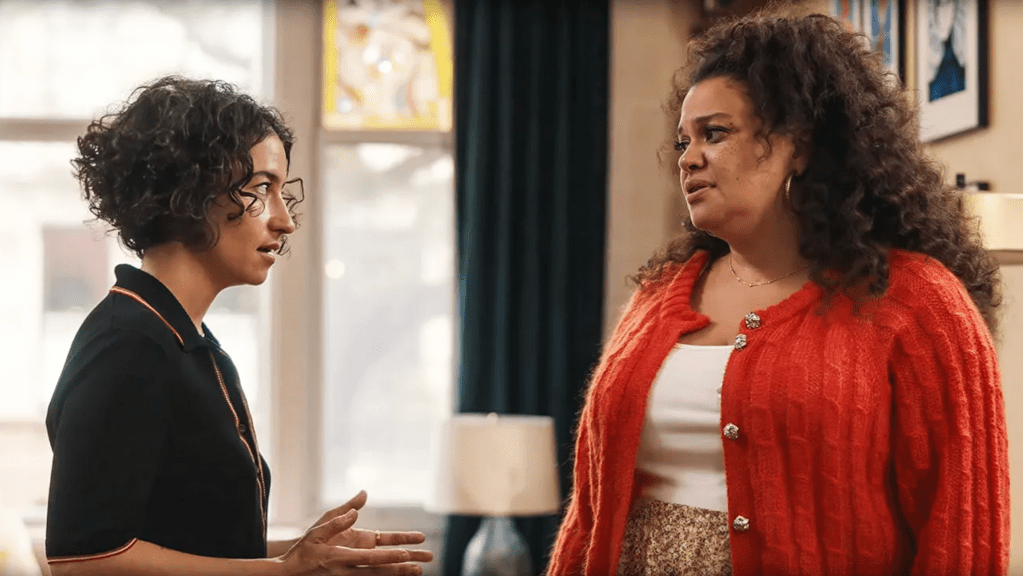
Babes is very well-reviewed. Since no one reads this site, and since I’m late to the party anyhow, it won’t much matter what I have to say to the contrary, so I’ll keep it brief. Though Babes has its merits – a few good jokes, a friendship that’s sometimes cute, a toddler embodying The Omen – I never could stomach too much of Ilana Glazer’s high-energy, stoner theater kid schtick. I’d forgotten that an unevenly Glazer-heavy episode of Broad City had always been enough to make me feel like I needed to retreat into a cave of introversion, like my social battery had been maxed, so, really, I don’t know why I thought Babes would be any different. If anything, Glazer’s relentless, over-enunciated energy is matched and weirdly refracted by Michelle Buteau, who’s less a foil to Glazer than a sort of doppelgänger with gravitas.
Glazer and Buteau play Eden and Dawn, lifelong friends who find their bond placed under strain by various acts of motherhood. Dawn has just had her second child and is dealing with a regressing toddler, a breastfeeding crisis and the claustrophobia of the endless shitstorm of a work/life balance. Eden, meanwhile, meets a man on a long journey through the New York subway, has a magical night of deep connection, decides she wants to try unprotected sex for the first time in her life, and winds up knocked up and on the road to single parenthood. Babes is written by Glazer and Josh Rabinowitz, but directed by Pamela Adlon. Adlon’s involvement is what got my ass in the seat, as the show she wrote, directed and starred in, FX’s Better Things is one I’ve recommended time after time to anyone who will listen – a sharp, beautifully rendered, funny and idiosyncratic take on mothers and daughters and being a woman in the 21st century.
Babes – I’m sorry to say – cannot make the same claim, though the film is best when it leans into some of what Adlon herself is so good at: the blend of funny and sad, articulating the intimacies and deep frustrations that emerge in families – or with friends close enough to be family. Those scenes are peppered throughout Babes, and Glazer’s writing is in many ways a natural fit for what Adlon has a knack for rendering. Both understand female friendships rooted in perverse honesty and a lack of a filter, and there are things Babes seems to – if sitting among my own friends is any indication -get so right about what so often isn’t discussed around motherhood beyond the blunt honesty of trusted, non-judgmental peers.
So, yeeaaaaah. There’s a good thing happening, but the full package is like being trapped in a quarantine with the most irritating theater kid you went to school with, and Adlon is bringing little of the pacing or aesthetic sensibility that made Better Things really hit to the generic rom com look of Babes. Consequently, even as the film’s dialogue may take you somewhere unique, its trappings make everything feel much like rote, Netflix “second screen” content. There’s a flatness to the New York landscape that feels like missed opportunity, and instead I sat there wondering if Glazer’s delivery had always been so vocally loud and abrasive even as her tone of voice often seems to be delivering something stagey and practiced. What irritated me the most about Babes was the way it felt like it collected dynamic nuances of a particular type of female friendship and experience only to deliver them in a way that emphasized how practiced and considered they were. Though the content of the dialogue stressed lived-in connection, the delivery never managed to make me believe it.
 love + squalor