
As a kid, I fell in love with art objects, became obsessed with them, fell into movies and books and music and TV shows with a fervor driven by a desire to consume in a way beyond the limitations of their form. I tried to write about this, once, itched at it over the course of lockdown as I tried to collaborate with a friend on a since-abandoned hybrid memoir. The process was tough, and one which triggered adjacent memories of adolescent difference, of a creeping suspicion the ways I thought and felt weren’t in line with what other kids were experiencing. Which is all to say, I was clinging to my episode guides of The X-Files when other kids were crushed out and doing what, I guess, they were supposed to do. I was trying to manufacture crushes, but I wasn’t sure I was feeling them. What I felt for The X-Files – as one example – I can admit now didn’t quite feel for human beings.
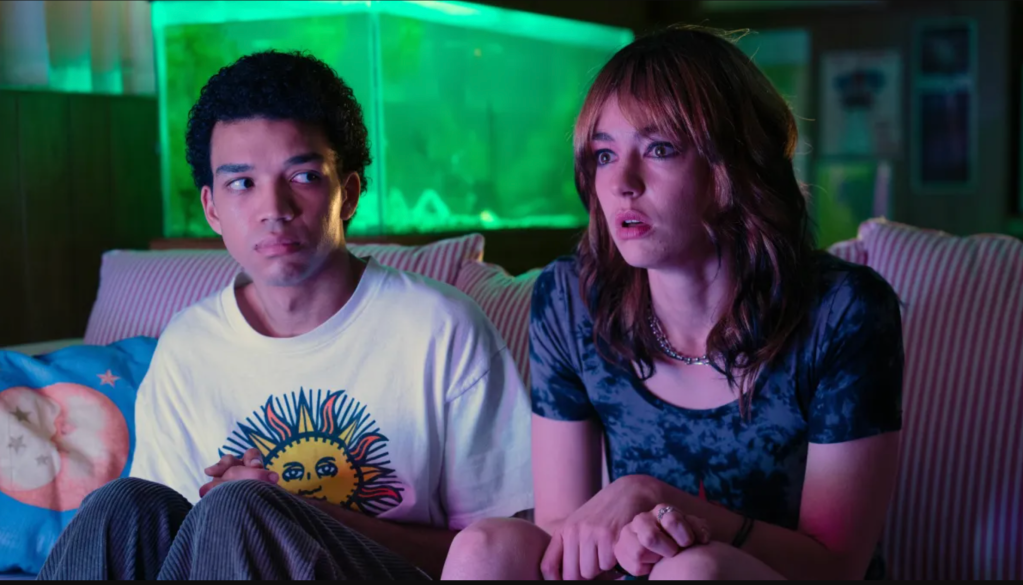
This is strange space I Saw the TV Glow sits. The film’s protagonist, Owen (Justice Smith), puts a spin on it, responding to Maddy’s (Brigette Lundy-Paine) assertion they like girls with doubt cast on their own sexuality, “When I think about that stuff, I feel like someone took a shovel and dug out my insides,” they say, “I know there’s nothing there, but I’m still too nervous to open myself up to check.”
At the Chicago premiere of I Saw the TV Glow, director Jane Schoenbrun spoke to something similar; the way they fell in love with Buffy the Vampire Slayer, the way shows like that one seemed to have the capacity to make the right viewer feel – themselves – seen. The sensation here is one entrenched in melancholy nostalgia; the particular sadness of a young person uncertain of who they are, trapped by boundaries outside of their control and acutely aware of the way the glow of the TV screen becomes a balm for a type of early ache of loneliness; something reliable and familiar in a time of ceaseless change, a time when we’re being pushed to answer questions we haven’t yet figured out how to ask ourselves. I Saw the TV Glow exists in this liminal space, where it feels wholly possible for the realities of adolescent weirdness to blend with the subplots of pop cultural obsessions, where we exchange childish play pretend with the fantasies of fandom. In the film, Owen is an overly sheltered kid who becomes transfixed by the mysteries awaiting them in a spooky tween show called The Pink Opaque, a show with a regular timeslot just beyond their bedtime (think something between Charmed and Are You Afraid of the Dark?). The call of The Pink Opaque draws them to Maddy, an older student who invites them to sneak out and come watch, if they dare – it’s “too scary” for most kids. What follows is descent and dysphoria, all of those aforementioned, terrifying feelings of the adolescent sublime fragmented through the surreal prism of The Pink Opaque’s world, the way its themes and characters and relationships have the power to pollute reality.
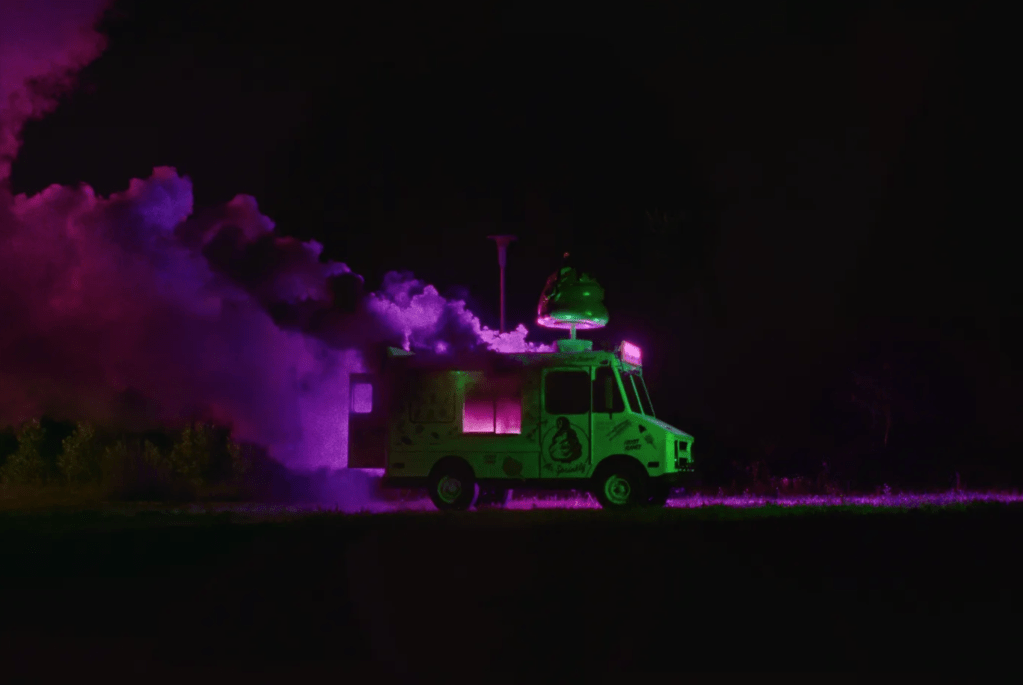
As a cinematic experience, it’s a beautiful and unique one. Maddy and Owen’s friendship is one cultivated cautiously, in VHS tapes stashed in lockers and vulnerable notes that reveal just enough for each of them to know they can never be seen speaking to each other in the school hallways. The show is their singular point of interaction, a bond so strong it connects them in a way mirroring how the “pink opaque” psychically links the characters they’re obsessed with. Tenderness is at odds with fear in their dynamic, and they seem to both intuit being seen with each other, being friends would be to admit something publicly they – or, Owen, at least – isn’t ready to face. Instead, much becomes sublimated, the TV show filling in more and more as a funhouse mirror to lives already mysterious for their own inhabitants. So people scream, they collapse, time freezes, hellgates seem to open, the Videodrome boundary is permeated, and we remember what it feels like to be so, so uncertain of everything we’re asked to be.
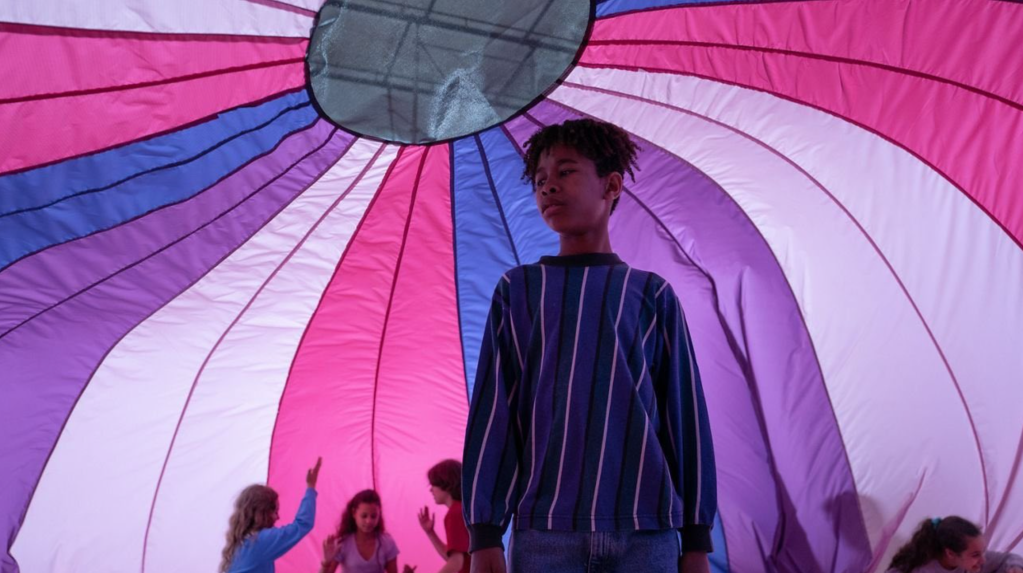
Schoenbrun has said this is an incredibly personal film, and this is both obvious and integral to pulling off – I think – many of the risks I Saw the TV Glow takes. The queer/trans narrative of it all is obvious almost immediately, apparent even in the billowing gym class-parachute, the maybe cheeky (look, sorry, but I heard her talk, the visual gag seems in-line with their humor) glow of the Fruitopia vending machine Maddy leans against. Without dismissing the thesis, but maybe belying my own tendency to think Roland Barthes was right about interpretation, I can say as much as this film very clearly speaks to a queer and trans process of becoming, it’s also a film that hits the nail on the head of just how terrifying it is to feel different – at all – in the tumultuous years of young adulthood. I can’t claim a trans identity, but jesus fucking christ did I pick up what this film was putting down. And wow did I start to dread having to talk about it with, like, normal people after the screening.
This is where the film succeeds; as an art object with a vague, compelling emotional center, and one with the power to find a convert or two at every middle school sleepover. As Schoenbrun’s second feature (after We’re All Going to the World’s Fair, a film I did not find as impactful), I Saw the TV Glow is a strikingly assured piece of work, with a clear sense of its own visual and aural language and an impressive disregard for doing anything other than exactly what it wants to do. I’ve quipped to a few people that this is a film that plays like it’s ready to be a queer Gen Z Donnie Darko, and from the vantage of a millennial who’s had that shit lodged in her consciousness for that past 20 years, you have to understand that’s high praise.
Of course, like Donnie Darko, I Saw the TV Glow is a film bound to be beloved by the audience who finds it and likely to draw some ire (at least for a few years) from the crowd looking for their Stranger Things nostalgia horror. That’s fine, I think, and I suspect Schoenbrun might like to keep it that way. The horror it presents you with is the horror of not belonging in your world or your body, and as unsettling as this can be to watch – the tension in several scenes is ratcheted remarkably high, the possibility of a twist to full body horror feeling ever-present, the way the film might bleed from the screen into the psychological reality of its viewer feeling, always, like a real chance.
 love + squalor
You must be logged in to post a comment.