
I didn’t expect to see so many half-considered mentions of a Henry James novella this week, and, frankly, it’s making me itchy. The occasion is one of adaptation. At the root of French director Bertrand Bonello’s genre-defying film The Beast is a re-imagining of James’ “The Beast in the Jungle”, a 1903 tale of one man’s descent into the fatalism of imagined cataclysm, of a protagonist so gripped by the absolute certainty tragedy lurks just around the corner that his participation in life becomes an act of passive observation, a space where he has failed to open himself to experience and the depth of genuine, human emotion. James’ work had a reputation for ornate, digressive sentences, a prose so often packed paradoxically with both heady detail and ambiguity. Sometimes, too, it had a reputation for being forceful in its repetitions, placing stresses as signifiers flagged for the uncertain reader. It’s a prose style I’ve come to love, but one that easily shifts from beautiful to punishing; overwhelming to the point of becoming frustrating or boring.
When I write it out for myself like this, I can see how Bonello’s The Beast could be said to carry the spirit of Jamesian prose to the screen. The Beast, too, is a maddening piece of work in love with its own digressions, obsessed with the setting of its scenes, and subtle as a hammer in its signifying repetitions. Sure. Ok. Not wrong. From here, though, there’s a close reading choose your own adventure: you can opt to receive each of the film’s innumerable signifiers as smart, deft, controlled bits of compiled commentary. Or, you can look at the film’s barrage of elements and wonder whether this isn’t maybe just a little bit like something that would emerge from the imagination of a very stoned liberal arts film major who’s read half of Cloud Atlas, fell asleep a little drunk and swiping through dating apps during Last Year at Marienbad and really wants you to know he saw Inland Empire before it was streaming. “What is love?” our stoned boi asks, “what is fear?” he demands, watching his ignoramus roommate filter a term paper through ChatGPT, “is it already too late?”
Look, all I’m saying is that both of these ways of reading could be totally correct. The question of whether either of those – in this case – add up to a good movie is a very different one. The Beast – while watchable in its puzzle-box presentation of shifting elements – is largely phenomenally frustrating and tangled in execution, and the payoff is comparatively slim.

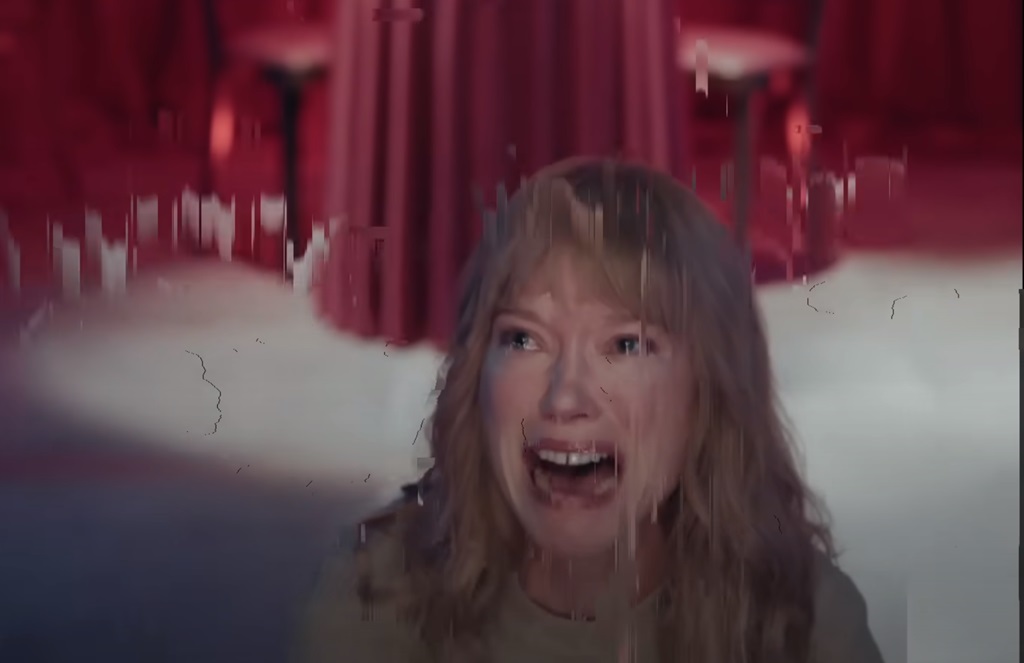
Where the novella centers around a man living in fear, the film’s protagonist is Gabrielle (Léa Seydoux), a woman we meet across three timelines. In 1910, Marienbad is evoked as pianist Gabrielle wanders Parisian corridors and salons with Louis (George MacKay), attempting to recall whether or not they’ve previously met at an instance in Florence where she revealed to him her creeping fear. In 2014, Gabrielle is a struggling model and wannabe actress, housesitting in Los Angeles and about to cross paths with incel Louis, who has been chronicling his misogynistic manifesto in video confessionals. And in 2044, Gabrielle is a human in a land ruled by A.I.. The climate is inhospitable, humans have been rendered useless, everything looks like the internet as depicted in Teknolust, and Gabrielle is undergoing a process to cleanse her past lives from her subconscious so she’ll be able – for whatever reason – to enter the work force and use the human skills she claims to have. Because The Beast is almost impossible to adequately sum up, what you need to know is the cataclysm in the shadows exists in the form of any number of real, manifested events across the timelines. Floods, earthquakes, electrical fires, the decline of humanity, computer viruses, murder, home invasion, the singularity as married with some loose implication we’re all headed toward a collective digitization. Piled on top of these anxious events are a surplus of other loaded symbolic triggers: a fixation with dolls, reproductions of the human figure in paintings and fashion photography, psychics and directors and micro-managing home owners and other mysterious orchestrators of fate.

I’ve seen and heard The Beast described as a sprawling sci-fi epic, as existential horror film, and, most troublingly, as star-crossed romance (if anyone tells you it’s that last one, btw, I suggest you make a run for it). Applying genre categorizations, though, are arguably useless as what the film is perhaps achieving most specifically is a kind of postmodern maximalism that renders damn near anything it decides to use as a referent almost immediately text and also hollowed out, damn near meaningless. On paper, the chaotic arc of The Beast is exactly what’s interesting to anyone who has felt, for too long, that it’s too easy to let most movies carry on as easily plotted, “second screen” fare. Any intelligent viewer will want to pull at the threads Bonello leaves hanging for them, and the knots they uncover will be satisfying, for a while, to work through. What they uncover, though, will only be a series of frays. There’s so much that becomes arbitrary to the point of eye roll here, and wondering at simple questions like what we’re supposed to make of the transposition of the love story, whether Seydoux reads as passive or inhuman, what it thinks it’s saying about fear, why we need the slasher-film turn, whether the film’s editing does it any favors, or why so many touches feel at all necessary to keep in the film’s already bloated runtime? These are largely fruitless endeavors.
What we can say is The Beast as smart (ass) enough to know that the more it overwhelms (even with boredom), the more it can be twisted into that being part of the point. On paper, again, that’s a cool effect. It makes sense. It works. It’s fun, maybe. On screen, however, I’d be lying to you if I pretended as though it didn’t sometimes feels as though I was trapped in the most navel-gazing, virtue signaling installation room at a contemporary art museum, the only one still sitting on a stiff bench trying to push the phrase “hack work” from being the thing I led with when I eventually escaped. Visually, it felt like a retread of a certain kind of 90s art film, a bit ugly. Spiritually, it was also just that, like watching a Lynchian cover band. As a friend said while leaving the theater: “sometimes you add so much to a French film that it makes it feel like the most stereotypical version of what people think a French film is.” Sure.
The creeping beast haunting the film’s anxious exploration into the way we detach from constant chaos is, perhaps, an ouroboros. In its glut of anxieties around the ways we can become spectators instead of actors in the human experience, it produces a strange, deadening effect of its own and falls victim to its own devices, eagerly consuming its own tail.
 love + squalor
You must be logged in to post a comment.