
on Midsommar as academic “quit lit” fable
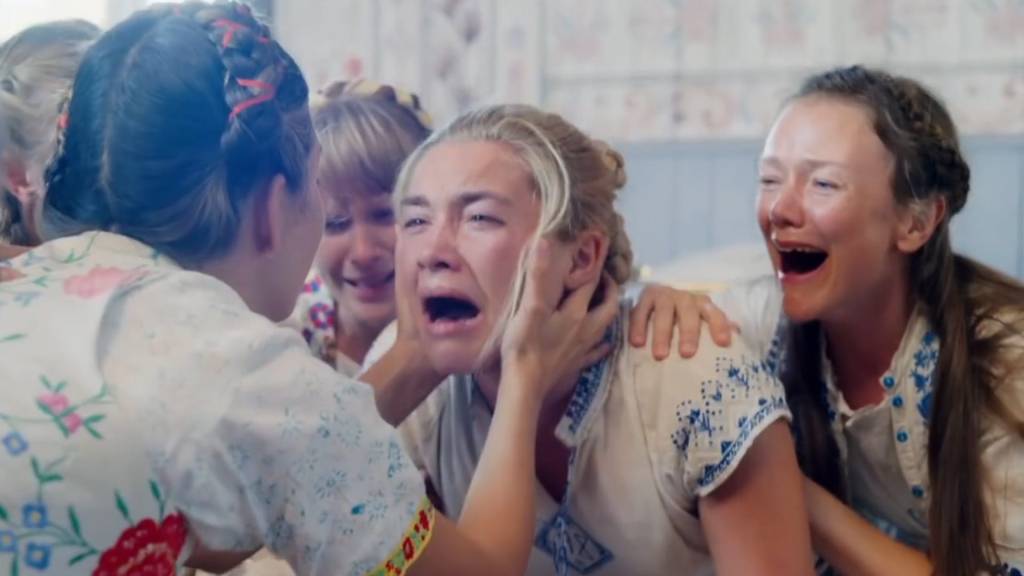
In its opening scenes, Ari Aster’s Midsommar stalks through a cavalcade of bleak, real world horrors. We meet Dani (Florence Pugh), a graduate student in psychology who has received a disturbing message from her mentally ill sister. There’s a finality to her sibling’s words that suggests Dani’s desperate attempts to reach her, their parents, anyone able to help, would already be too late. Dani’s dread is juxtaposed, immediately, with a scene of her boyfriend, Christian (Jack Reynor)—a fellow would-be academic—sharing drinks with a male cohort. Her concern is flagged by the men as a type of hysteria, and she’s marked as distraction; someone not worth their collective time or energy. It’s clear Christian has been on the verge of breaking up with Dani, and also apparent the film won’t be presenting him with the opportunity to do so. It should go without saying that what we see next is confirmation of Dani’s intuition, a realization of her greatest fears: we float through the dizzying aftermath of her sister’s self-destruction, forced to watch as the camera glides over a gruesome tableau of familicide, the whole clan linked by tubes of gas, demolished by something silent.
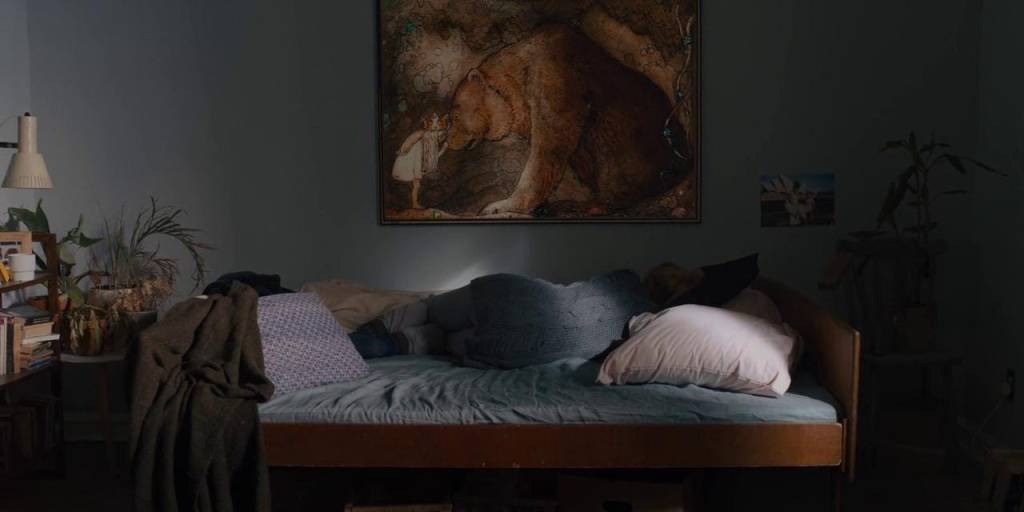
There’s a terrible poetry here, of course, and one that’s in keeping with the blood panic and family trauma of Aster’s other work: Dani is perhaps her sister’s mirror, troubled in her own ways. Dani is, too, the lone survivor, the person who has escaped the quiet fate of her family. Yet Dani, curiously, has devoted her life to studying psychology, to understanding someone like her sister’s struggles head on. As she tries at the film’s beginning to approach her sister logically, she is met not with dialogue, but with aftermath. Everything Dani thought she understood is canceled out: nothing is logical, language has no place, she can’t understand it, and nothing in her education can account for it. In the absence of reason, she’s reduced to something primal: a howling despondency. Dani’s world has crumbled, and in the midst of suffering grief she also suffers a likely crisis of ideological faith; everything she’s tried to understand, all the practices that guided her perception of the world, are null and void. This is where the primary action of Midsommar begins and the film turns: Dani—with only a tenuous place in her reality—travels with her boyfriend and his gaggle of privileged anthropology grad-bros (who seem to be weightlessly tripping through an “ABD” vacuum) on a “boys only” jaunt somewhere in Hälsingland, to the rural Swedish commune where one of them —Pelle (Vilhelm Blomgren)—was raised.
In Sweden, the boys plan—ostensibly—to observe the “theater” of a village festival for reasons that blur the lines between pleasure seeking and academic interest. Studious Josh (William Jackson Harper) intends to travel the continent, engaged in a survey of midsummer Pagan rituals. Christian is clearly riding his coattails for a summer escape. Pelle is returning home. The performatively misogynistic Mark (Will Poulter) seems mostly keen on hooking up with “milkmaids”. Dani herself is a slightly different take on horror’s textbook Final Girl. She’s still a type of social outsider here, just left of the group and observant in a way they fail to be. Though her male peers find her weak, trauma has shaken loose a shift in perception her male companions lack. Her life has already been disrupted by misguided ritual and rationalization, her psychological training already ineffective in the face of real crisis. Dani seems aware she is being led to a proverbial (or quite literal) slaughter as the boys slog forward without question. Because this is a horror film, the violent disruption in Dani’s life can only lead to further bloody spectacle: another, and another, and another still.
You’re beginning to have a sense, maybe, of the smudged lens through which I read Midsommar’s crooked runes, and maybe a working thesis for why I’m starting to write about film again, after all these years. Aster offered his own explanation of what happens in the film, as did Pugh, not to mention an endless run of critics. In a flurry of “what does it all mean?” jabber, Midsommar was most often simplified into a breakup revenge fantasy, another horror movie about grappling with outsized grief, a commentary on American entitlement, a fairy tale riff on existing in the world as a woman, a trans narrative, etc etc. As is usually the case with the art I tend to become the most immediately obsessed by—Midsommar opens itself to all of these readings, becoming a Rorschach test for each individual viewer. This is where I admit to you that – in the tradition of so many self-absorbed academic-types —I heard “graduate student” in the film’s opening minutes, fell into wary self-recognition, and began to see everything through the lens of the academy, the milieu I—much like Midsommar’s characters—am still struggling to escape even as I’ve moved to another job, another world, felled by one of its most sinister villains: active resignation.
True, there’s a dying romance at the heart of Midsommar, and yet as we burn on, Aster’s “break-up” elegy becomes one less centered around toxic love, and arguably much more invested in the cultish co-dependency of established institutions; a damning indictment of the university and any system that thrives on new blood, on the consumption of its young, to perpetuate practices many would argue are dead or antiquated. Academia recycles only to maintain the way things are, the way they have always been. When I first watched it, at the tail-end of an academic career and struggling to start making my way out, Midsommar unfolded as a type of “Quit Lit” fantasia, a pitch-dark fable on attrition and the problem of rigidity in academic systems.
I likely don’t need to tell you that much has been written in recent years about the university as existing in a state of collapse, and indeed, I’m a casualty of this implosion: when I stopped writing casual movie reviews it was because I’d entered a graduate program where studying the humanities (including film) had destroyed the process, the joy of a critique rooted in artistry, merit or enjoyment over some constructed argument about its value. You can see what I mean, I’m performing it—to a degree—right here, right now.
I made it through the machine only to scrape by as contingent labor, and I can count on one hand the friends who have successfully snagged the “right” job. Instead, my peers—like me—have gone corporate, have either stopped writing or are penning and passing around Quit Lit sagas, contributing to a familiar cycle of academic grief: what begins with excitement and a denial (we love what we’re doing anyway! We could be the one to ride the last unicorn to a tenure track job! Conditions will improve!) gives way to an anger (the institution isn’t trying to correct its own problems! Why are programs accepting graduate students with an ever-shrinking pool of jobs!?) and then comes the depression, maybe the bargaining. It’s unclear, at present, how many of us will be truly capable of acceptance, and in some ways Midsommar presents an imagining of the dangers of that resignation. What we understand is that though much posturing had been adopted by the tenured members of our committees, and many articles have been published about the need for recalibration, even after global cataclysm, the university can’t help but be devoted to its oldest rituals, in love with its pageantry, fueled by the devouring of its own tail. Midsommar presents its viewer with a variation on all of this, and it seems a fitting turn for institutional grief to transform into horror, for Quit Lit to be displaced into a new medium.
In Midsommar, nobody raises their fists to the heavens as they wail about the lack of tenure track jobs (and thank goodness, truly). We never set foot in a classroom, or within walls recognizably belonging to a school. And yet, the fingerprints of institutional logic can be found everywhere, staining everything. Dani and her fellow travelers leave one system only to enter a mirror hierarchy, to confront the academy in what—curiously, and always—is perhaps its most visceral form: as metaphor.
There’s no summer respite this cohort, as there’s no respite from grief, as there’s no respite from the anxieties of intellectual labor. When Dani and company take a vacation, they find themselves participating in the procedures of a different, closed-off community, yet one with similar barriers. Before they’re even allowed to enter—or in Pelle’s case, reenter—they must wait outside the village for a period of time, a process Aster presents to us via clever, obfuscating devices. They’ve traveled north enough to enter a land of midnight sun; days blur together, night only minimally arrives, time melts away further as they are invited to consume hallucinogenic mushrooms from one of Pelle’s communal “brothers” and we enter Dani’s point of view—the bark of a tree gently undulating, the hillside shifting unnaturally. Basically, before these scholars are greeted by the Hårgan people, they’re asked to shift their perception, alter their way of seeing the world without questioning the reasons why. There’s a demonstration of pliability here; a willingness to be molded, to perform being open-minded enough to continue forging forward even as what lies ahead is impossibly withholding. The psychedelic experience is repeated later, introduced as a means to “Break down your defenses and open you for the influence.”
This is the way we see here, if that doesn’t sum it up, I don’t know what else could.
Now “open to the influence” the band of outsiders is walked through a cursory orientation to both the Hårga and the festival. The rules and rituals are many: the event takes place over 9 days, a May Queen will be crowned, a bear sits – mentioned and yet unaddressed—in a cage, a panel of witchy folk art depicts a step-by-step process involving hair and blood, a golden pyramid no one is allowed to enter sits at the horizon. Presiding over the festivities, a stately elder —handsome, but never truly sinister on camera—introduces the mayhem with repetitive, incantatory instructions to underlings carrying torches: “This fire. No hotter, no higher,” she instructs. And yes, let’s be real: isn’t that often the way with mentors? Follow my lead, hold my ideas, don’t surpass my brilliance.
With this, Midsommar introduces a collection of vague endpoints presented with authority and aplomb by robed people indistinguishable from the collective and yet marked, throughout every step of the process, as higher up on some vague hierarchy. Questions about what lies at the festival’s conclusion are swept away by the illusion of access: guests are granted permission to ask questions, to participate in praxis, discussion, enthusiastic proclamations about the why and the how that answer nothing and yet gesture in all the right, politically correct directions. Suddenly, we too want to gain entry into the Golden Pyramid, we want to be crowned May Queen, we want this though no one is bothering to mask the ritual’s rot, though we can read the warning signs painted on every wall, can see the 600-pound bear in the room, and can recognize we have been paradoxically told to ask questions, yes, but never to trespass or raise our ideas too far beyond what is accepted.
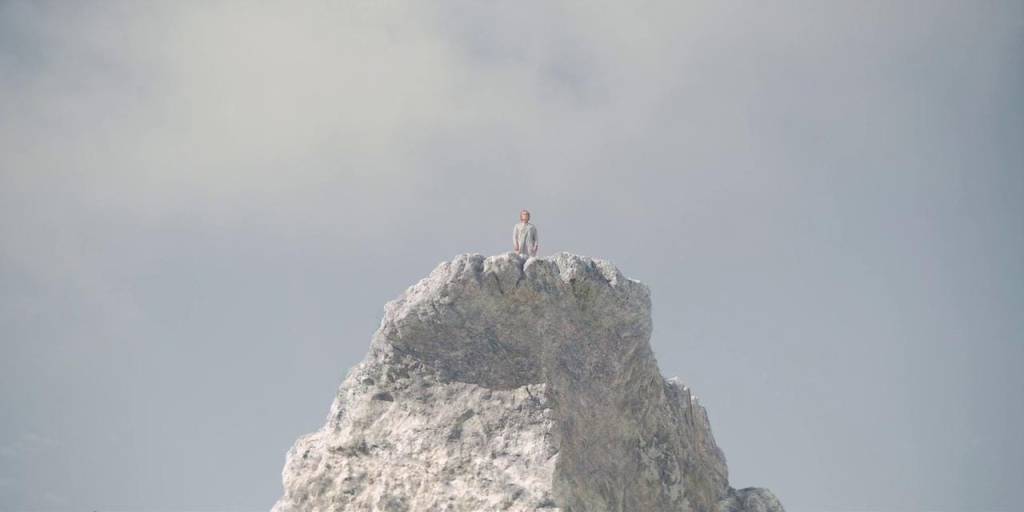
It’s no surprise, then, when what’s rotten becomes harder and harder to ignore. Midsommar is a slow burn, but not a horror film that bothers delaying gory gratification. One of the cohort’s first cultural experiences concludes with a ritual double suicide: two elders sacrifice themselves in a gesture of renewal, slitting their palms open to streak blood on ancient, carved runes before diving – one after the other – off a cliff. One lands with an explosion of the cranium, the other snaps his legs but is not quite dead. This failure means he must now be bludgeoned repeatedly by different members of the community, in the head – well past the point of death. The film takes pains to present us with the gratuitous money shots here, worth noting because, come on, what sort of “renewal” involves the destruction of a town elder’s brain if not one centered on a cannibalization of ideas?
The camera takes pains to make us understand our cohort has witnessed something shocking, and we’re shown the aftermath repeatedly. We are all confronted with the events as fact; not theater as Pelle had promised, not effigy, not excusable. And yet, the ritual is explained away – a subcultural norm – and their immediate panic is greeted with a reassurance that this was an honor for the departed. To end one’s process like this, to participate in a cycle of renewal, this is a community member’s ultimate purpose. The cohort, as new blood, must accept this.
This is where Midsommar makes a choice not dissimilar to Hereditary’s complete disinterest in providing consequences and real-world closure for its own headshot. Where Hereditary moved on from the sudden death of a child without the intervention of authorities, Midsommar moves forward as its key players barely flinch. It’s a character response frustrating to many, and rightfully so. Where in a different film we might expect our American cohort to view this scene more naively, to be sickened as they should be, and to decide to plot a perilous escape – saving their own skins – here their shock transforms into morbid fascination and they resign themselves to acceptance. As much as the sight of a grisly double suicide is recognized within the film as outside of acceptable practice, Dani, Christian, Josh, and Mark make no real effort to turn away from it. Instead, Josh promptly takes to a diligent study of Hårga customs while Christian, adding another layer to the cycling and recycling in process, informs his colleague he now also intends to write his thesis about the Hårga, and that he’s willing to accept Josh as either collaborator or competitor.
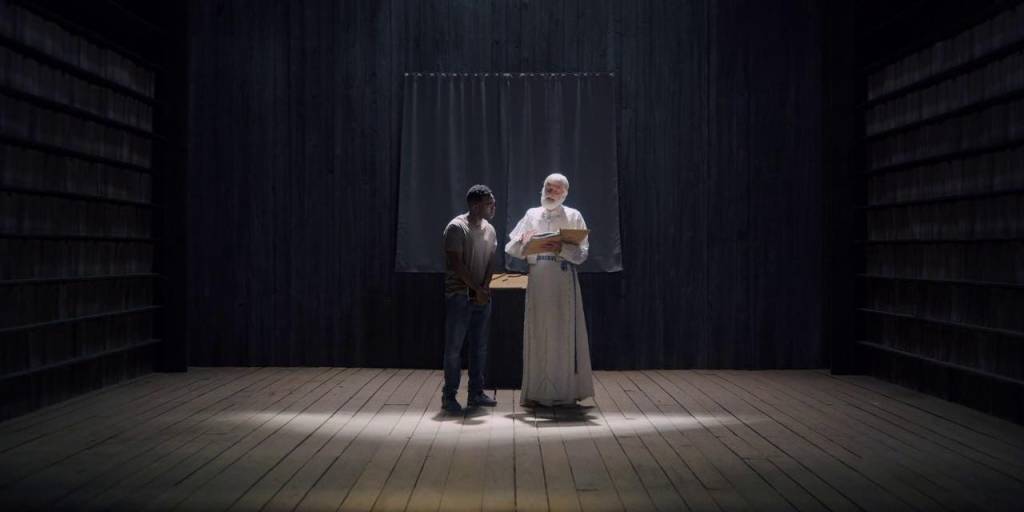
Josh and Christian’s dissertation face-off is the closest Midsommar comes to overt integration of academia in its folk horror. The notes of privilege and entitlement enter a fever pitch here too, not only as all the Americans take to a type of cultural tourism, but as Christian—a white man—brazenly offers Josh— a black man—co-authorship of his own co-opted project. Here the film’s characters argue about how futile their writing actually is, that there’s no chance of the secrets of the Hårga getting clearance from a peer reviewed publication. They’re right, of course, in a way that seems a knowing joke within the film. The two have embarked not only on parallel projects, but in research with no future, no chance of a readership. Already the double suicide rematerializes, in a way, reborn as the academic fates of Josh and Christian are stamped with an expiration date. As the two race for permission and favor with the village elders, gathering a makeshift committee, they begin a pissing contest of ingratiation that demands they actively dismiss having witnessed something straight-up bat shit insane. Mark – the class clown in their midst – is meanwhile targeted when he literally pisses on a sacred ground, desecrating “the ancestors,” ignorantly leaving his stink on something he has stumbled into and failed to read properly.
Dani is—of course—the only member of the American cohort who seems at all concerned. Unlike the Final Girls outlined by Carol Clover in Men, Women and Chainsaws, however, Dani’s response doesn’t seem to be about a traditional survival. In the face of extreme warning signs, those who hang on the longest are those who simply continue to accept and acclimate, those who choose to overlook the danger they face in favor of a passivity, a self-sacrifice, a willingness to play the game, and perhaps – in Dani’s case, especially – a doubt that there’s anything waiting for them in the “real” world. Dani floats through the rituals of the Hårga in a way different than Christian’s try-hard dissociation with his own past. The villagers explain to their visitors that they’ve been invited in only so the population might escape incest. The machine demands hybridity, new blood, new ideas. At the same time, however, the visitors are also told the truest oracles are deliberate products of inbreeding – individuals spawned from what has never been outside institutional walls. The Oracle is presented to us as a person deformed and sacred, outside of the rat race, allowed to rest and observe as events occur around them. The Oracle’s scriptures are paint-streaked illegible texts, a child’s finger-painted smears to be read and interpreted like “an emotional sheet music,” something “forever in progress.” Again, our interlopers receive a clear warning: while they may serve a purpose, ascension is not actually possible for them. A canon has been fixed, procedure is set in stone, only certain interpretations will be accepted, though the ideas central to the town’s existence are always in the process of being translated into blurrier and more abstract smears of word vomit.
It seems to me academic online discourse is often engaged in watching variations of this same cycle occur. We acknowledge all the warning signs, prematurely announce our intent to fail differently even as we attempt to construct a sturdier and more codependent engagement with what may be about to destroy us. We actively work to ingratiate ourselves, build the right bridges, pick up old ideas, loudly scream our support for seriously inbred texts. We write them new again, translating them back to life or mercilessly pitching them from a cliff in the name of revolution, renewal. We force ourselves into a system that reveals to us, time and again, just how much it will ultimately make its selections from a pool of the already chosen, that when we enter as outsiders, if we manage to make it our ascension will merely be seasonal – just a May Queen, just temporary labor—never an Oracle, just someone with control over a single ceremony. The illusion of agency is tempting, and though we watch as our peers are torn apart by a system that once welcomed them, we find, too, that as long as we’re failing upward, as long as the illusion of what we’re stumbling toward remains intact, we are capable of rationalizing bad behavior as in service to a larger, moral good.
As Midsommar enters its fever dream of a final act, the act of rationalization is revealed to be the film’s truest villain, with resignation as a second in command. Dani and Christian – the only members of their cohort still standing —have no choice: they immerse themselves even further in the rituals of the Hårga, ready to win or defend their place in the world though they have no proof of life on the other side. It’s worth noting that Aster manages to create such a claustrophobic sense of structure that the possibility of walking away never feels viable, even as the setting is one entirely composed of wide-open spaces. So it is that after the earlier disappearances of their peers and one sleeping pill-induced nightmare of abandonment, Dani and Christian don’t really mention departing. They’re in this now: Christian has been “approved to mate”—a collaborative set-up—with someone he has never met, who he has no interest in. He’s guided and encouraged to do so in a way he seems neither to accept or reject, but sees perhaps as an opportunity. It’s a sexual violence, an uncomfortable coercion in which he prepares, reluctantly, to strip down and go through the motions.
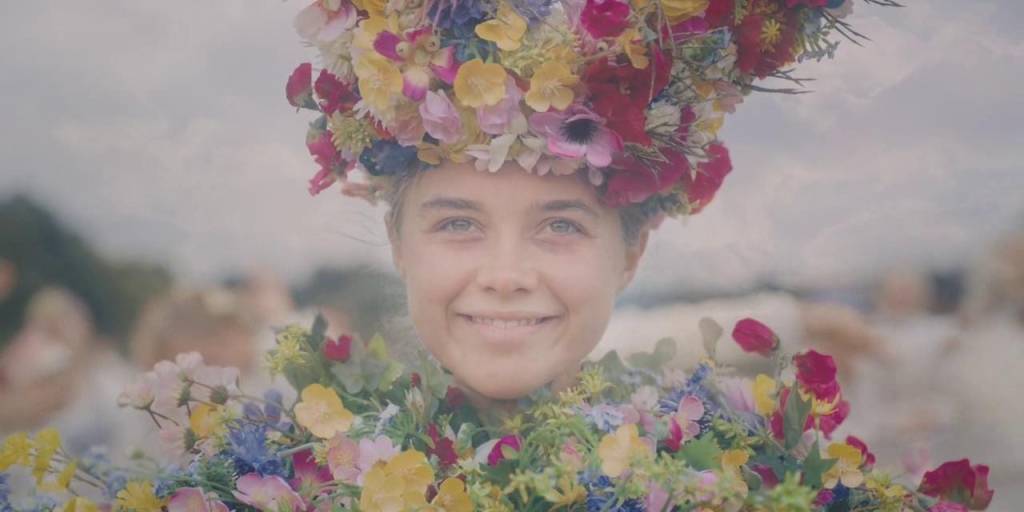
Dani, meanwhile, undergoes a metamorphosis. Plainclothes are replaced by the full Hårga regalia, she’s hooded in flowers, drinks the Kool Aid, participates in the dance around the Maypole that serves as endurance test. She enters the race of the job market, throwing her hat in the ring for May Queen as Christian remains behind schedule on his own journey, flailing, trying to renegotiate his place in the system. “We dance until we fall,” the elder instructs at the Maypole ceremony, and the village’s younger women move in concentric circles, colliding into each other, falling away in fits of laughter and pain, a nervous breakdown in action as they are commanded to stop and start and stop again. When Dani is crowned, we are far from surprised. “The queen must ride alone,” we learn, and we watch as she ascends warily while Christian’s attempts at participation become a coached violation: a full panel of naked villagers singing him through what’s – at best – an act of nervous copulation, a death knell debasing.
The twinned events: Dani’s temporary ascension and Christian being – essentially – fucked by the very system itself, present us again with the film’s central horror and a bleak truth: given the right conditions, the worst abuses (of self and others) can be rationalized. A cult logic, familiar from works like Shirley Jackson’s “The Lottery” or, more relevant here, Ursula K. Le Guin’s “The Ones Who Walk Away From Omelas” insists that for the Hårga to carry on with their way of life, acts of selective sacrifice must be observed. Where Le Guin offered a thought experiment contingent on whether utopian conditions for many were worth the limitless suffering of the few, Midsommar does away with the question and presents us with a situation that distorts the stakes of the situation so much it becomes impossible to see another option beyond Dani’s best case scenario.
In her hood of pastel flowers, it’s Dani herself who selects Christian to be the festival’s final victim. He’s betrayed her, yes, but even more so he has failed, is hobbled, aimless, someone who has already provided his contribution to the discourse with much coaching, who is ineffectual on his own. The promise of Christian cannot be fulfilled, and so he is stitched into the carcass of that now dead 600-pound bear and locked up in that Golden Pyramid with those who volunteered to be burned alive. Christian embodies an unmentionable thing, a problem Dani now must resign herself to contributing to even as she participates in a cathartic performance of emotional release. The village onlookers do their part — the chorus always does, after all. They look on as the Golden Pyramid burns and they wail, contort, seize, cry out in ways we interpret as fear, grief and confusion all at once. They scream their rage into the void, responding to one another even as they themselves have ferried these newcomers through the process of seduction, coercion, milking and immolting for the good of the system. The ritual has seen itself through yet again, and now Dani and the others resign themselves, enact their survivor’s guilt and laugh through their burden because they have already yelled, because it’s unclear just what comes next or just what place they themselves have in the larger machine.
And this is where I begin again. I have left, I have learned, I lost one way of writing, I found a way of seeing, I have belabored my ideas and couched my opinions and invested everything. Unlike Dani, unlike Midsommar”s cohort, I get to cross back to the world I left behind. What happens now?
We dance until we fall. We dance until we fall.
 love + squalor
You must be logged in to post a comment.